Functional Testing Interview
Tell me about your self - Nirmaan
I am swetha vechalapu.
I have 2 years of experience as software engineer in ASM IT Solution.
As a software engineer I worked on developing static web pages using html and css. I also automated it using selenium.
I also have 1 year experience as HR in Nirmaan.
Explain in detail what are things you working in nirmaan ?
I handled Onboarding and exit formalities.
I handled HRMIS document, where we track all the details of employees.
I also screened candidates and arranged interviews and followup with them.
I also used linkedin, naukri to identify potential candidates.
Involved in campus hiring in multiple colleges
Explain about your project in ASM I solution ?
Mainly I working on developing static webpages using html and css.
I also working on automation using selenium for the same websites.
We used to get requirements from clients. Based on requirements I develop webpages and deploy them on C-Panel.
I also test them using selenium, I have good knowledge and xpaths.
Why did you take career break after your marriage ?
My husband working in hyderabad, but my job is in bangalore. They asked to come to office, for me relocation become difficult, so I took break.
Which one you prefer software engineer or HR?
I am ready to work on any role right now.
Tell me about your self
I am swetha vechalapu. I have total 3.5 years of experience in software testing.
I have knowledge on manual testing, software testing life cycle, writing testcases, exeuction testcases, writing xpaths and updating xpaths.
I also have knowledge on developing static websites, using html and css.
I am working in ASM It solution. Coming to my background, I complete MCA.
This is overview about myself.
Explain your day to day activities. / Explain about your project
Mostly I worked for small applications like Dwitiya life care, JSW Infra, ASM IT Sol.
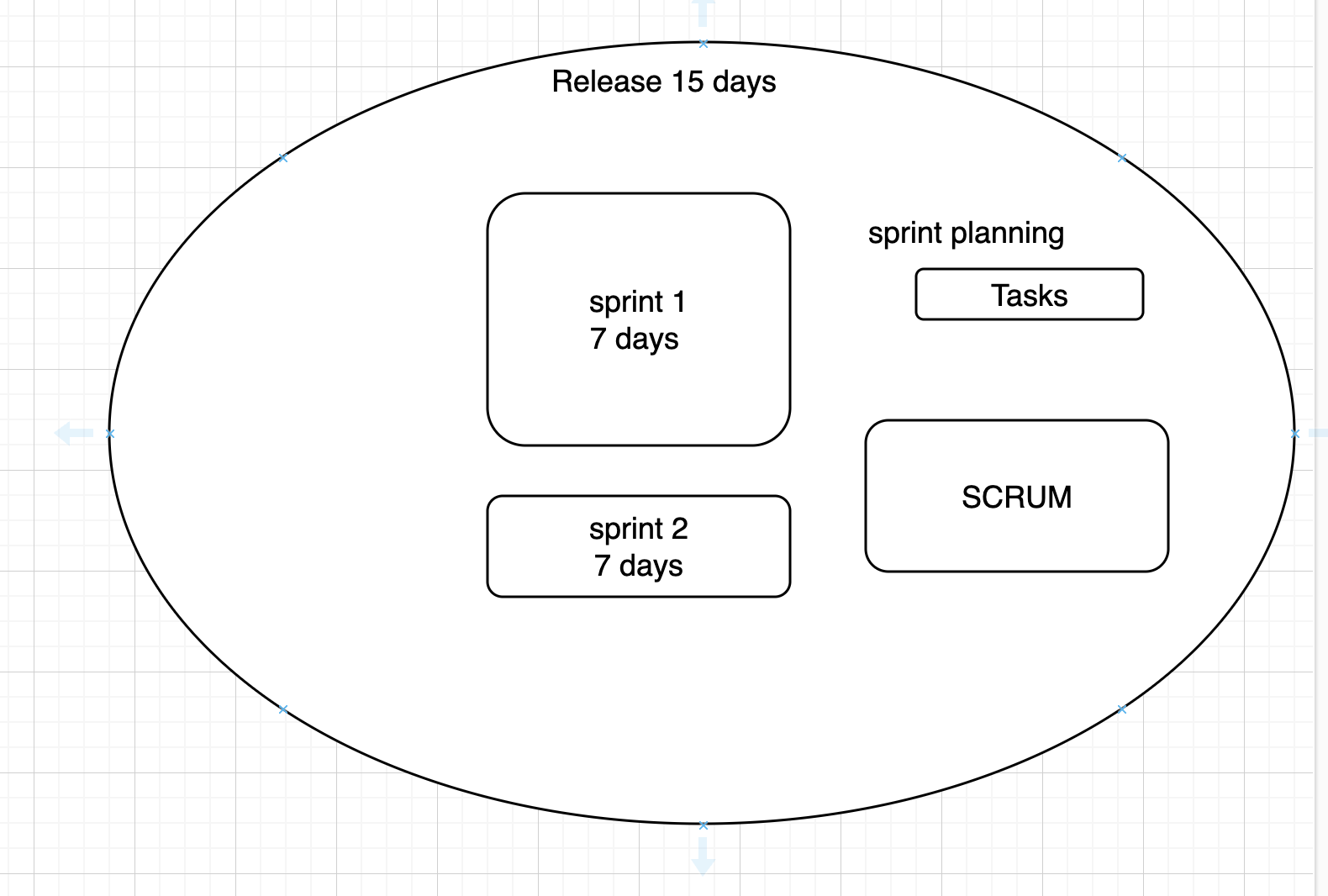
For every 15 days we have release. Every 15 days we do sprint planning. I mostly work on writing testcases, executing testcases and Automating testcases. Every day I will attend scrum and pick the priority item. It can be writing testcases or execution testcases or automating testcases.
If task is related to testcase writing I will go through SRS document, based on usecases, scenarios and figma design, I will write the testcases.
If task is related to testcase execution, based on target env(dev,qa,uat) I will execute testcase and create bugs.
If task is related to automation I will work on automation.
What is your last working day ?
My Last working day is already completed, last friday is my last working day.
Explain about your automation project / framework ?
We use Selenium with java for UI Automation.
We use page object model.
We have New feature automation related tasks.
- Whenever new page is developed, we will create a new class and add all locators and method related to that page.
We also have Maintenance related tasks
- If any existing page is modified, we will updated xpaths in our automation code.
What is Page Object Model ?
For every webpage, we create a class. That class has all locator related to that webpage. That class also have resuable usable method like login, logout.
Explain about your release process
We have a release for 15 days.
We will get requirements from product managers. In SRS documents we will have usecases(scenarios) and figma designs.
Based on SRS document we will write testcases.
We have 4 enviroments. They are dev, qa, uat, production.
Code is deployed to dev environment. we will do feature testing and regression testing. Then we will give sign off.
Same process is repeated for QA and UAT environment.
If everything is fine then code is deployed in production.
Understanding Feature testing & Regression Testing release by release
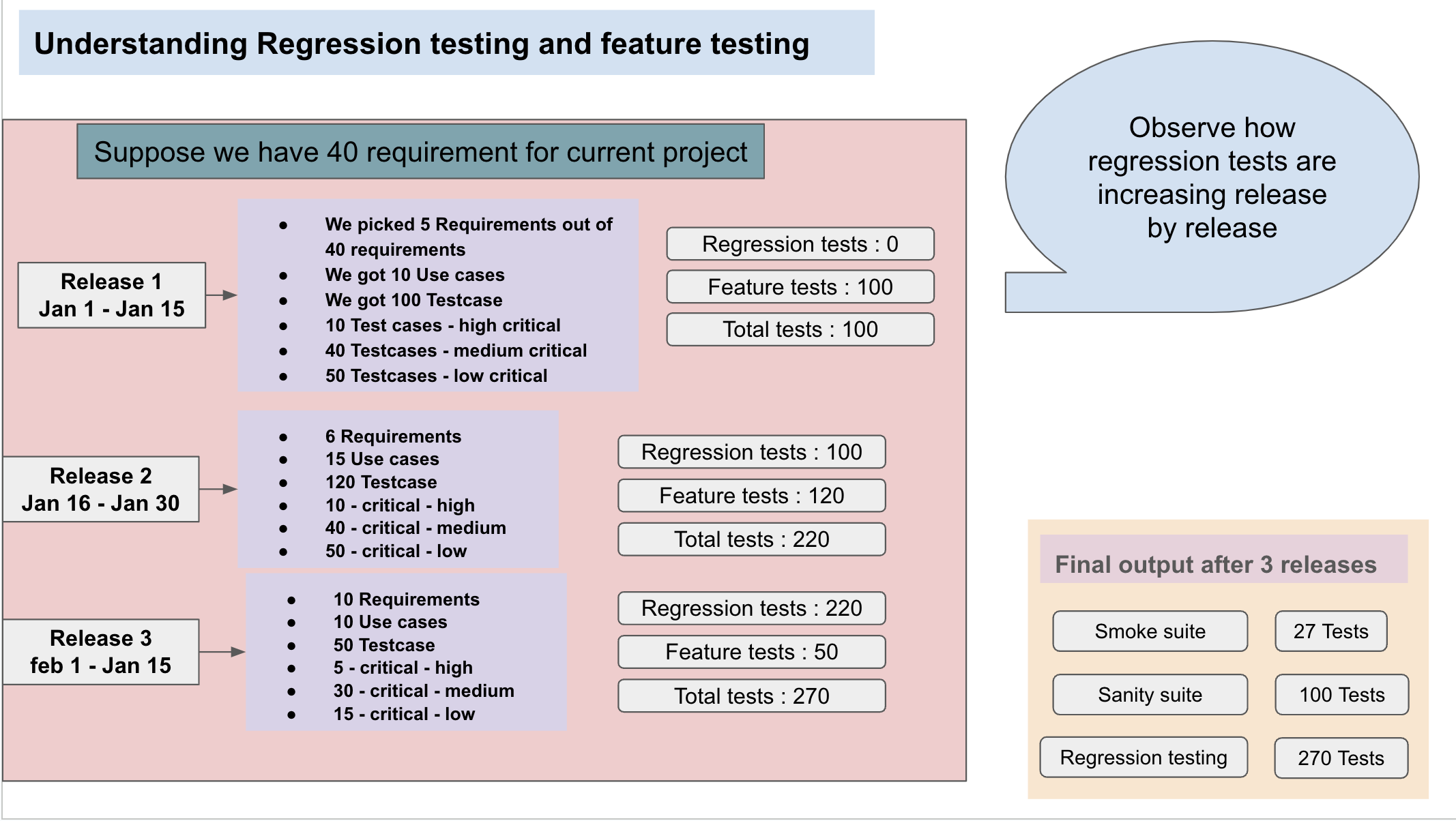
What are test suites?
Group of testcases is called testsuite.
Test suites can be grouped by criticality of tests
- Smoke suites, Sanity suite, Regression suite
Test suites can be grouped by modules of application. For example Gmail Application
Inbox test suite - 40 testcases
Sent Items Test suiets - 25 testcases
Settings test suite - 30 testcases
Send Mail pop up suite - 50 testcases
Note : Regression suite = Inbox + Sent Items + Settings + Send Mail tests
What is Testing Scope ?
For every release we have two choices
Execute Complete regression Suite and provide sign off.
Execute only Some Test Suites and provide sign off.
Testing scope tells whether you need to execute complete regression suite or you need to execute only specific suites.
Why ?
Due to limited testers and limited time, sometimes for every requirement we can't do complete 'Regression testing'. We select some Test suites related to requirement and we will execute those testcases.
What will happen if you get bug in production?
Based on bug priority and severity we will do hot fix.
Will you do regression testing in production ?
No. we will only do smoke and sanity testing in production
What are Smoke/Sanity/Regression tests?
Smoke: Smoke is build/deployment verification testing. In smoke testing we will test important and happy path usecase.
Sanity testing : Sanity testing is next level of smoke. we will cover more usecases compare to smoke testing. Sanity testing purpose to get confirmation that product is ready for regression testing.
Regression: When a new feature is added, testing the old features are not broken is called regression testing.
How do you prioritise your work or If you have 5 items which one you will pick ?
Whatever item important to release I will pick that item. for example
if we are at the end of release we will most try to execute all testcases and try to give sign off.
If we are at the starting of the release I will work on understanding SRS documents and writing testcases.
If we will get bandwidth(time) we will work on automation
What are the environments present in company?
In our company we have DEV, QA, UAT, PRODUCTION environments
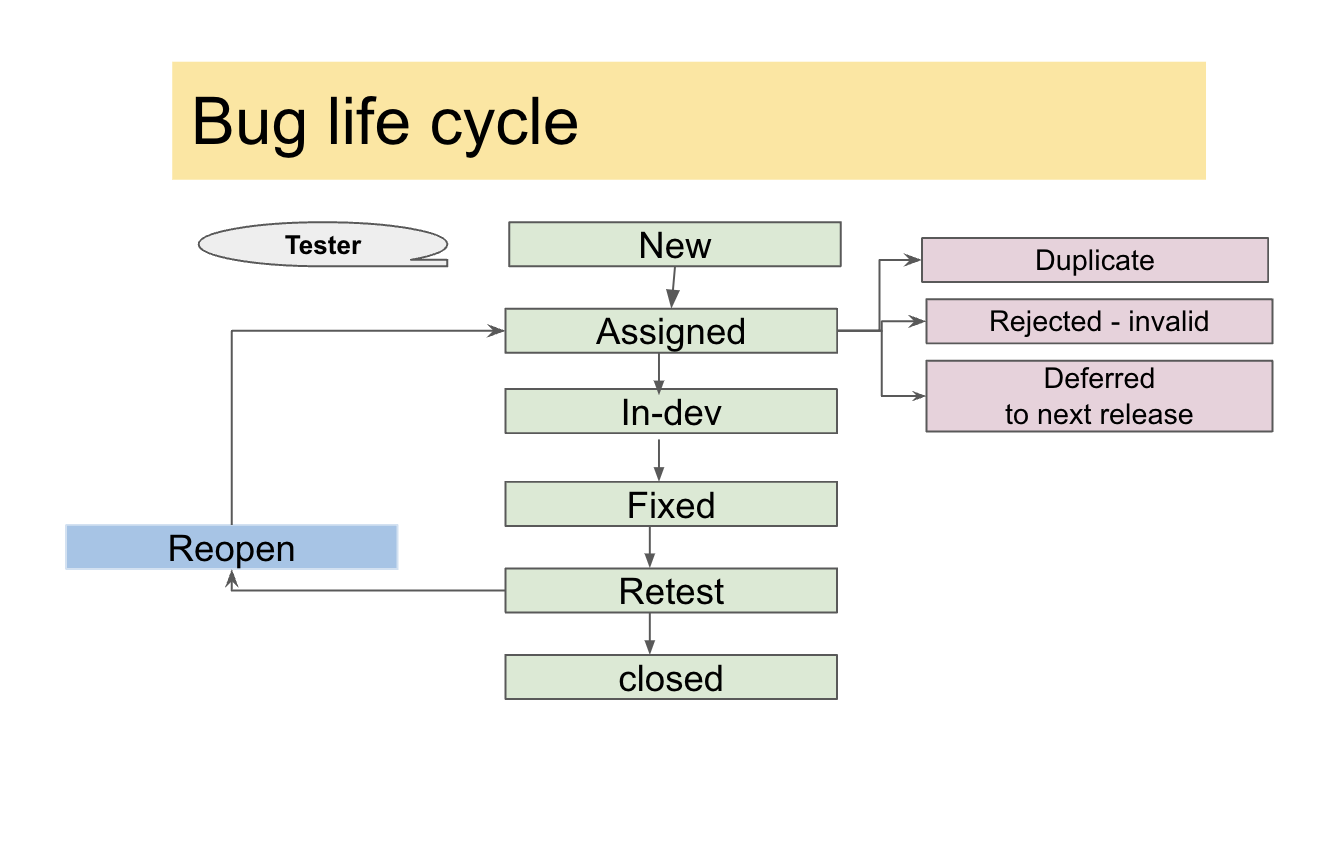
Tell me about bug life cycle/defect life cycle?
Bug life cycle
| We will Identify a bug and assign to the Team leader. Bug status will be OPEN |
| Team leader will assign to developer. Bug status will be Assigned |
| If it is invalid/duplicate it will be Rejected. |
| If it is valid, developer will work and move to In-dev status |
| Once it is fixed, it is moved to Fixed status |
| If testing is inprogress, status is moved to Retest |
| Once tester is verified, status is moved to Closed |
| If bug is still present again, the status is moved to Open |
| Some times developers will not get time to fix the defect so it will moved to next release. It is called deferred. |
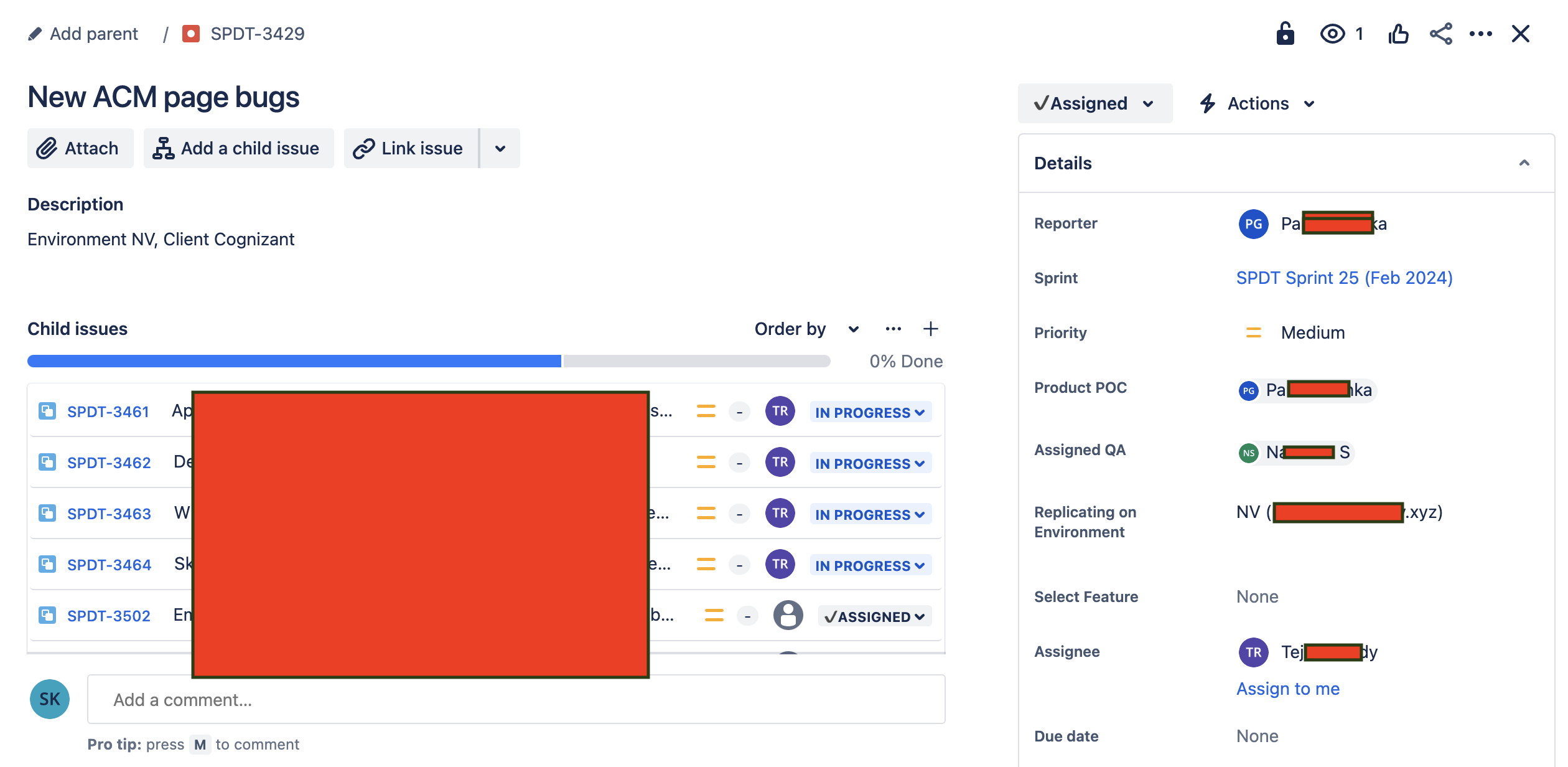
What does bug contains ?
| Title |
| Description |
| Env : qa/dev/uat |
| Credential : users |
| Detailed steps |
| Screenshot/Videos/files |
| Status |
| Reportee |
| Assignee |
| priority |
| severity |
| sprint number |
What is STLC (Software Testing life cycle)?
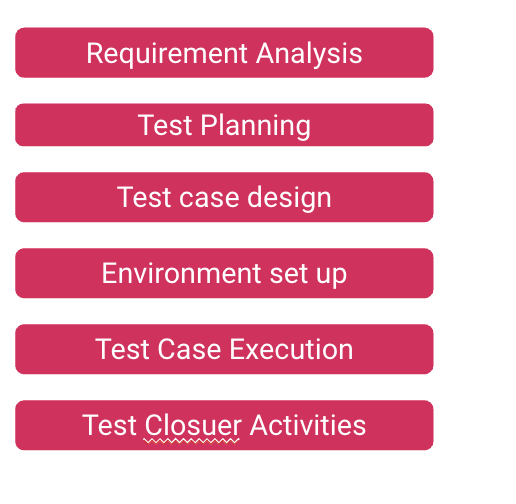
In STLC we have 6 phases, Requirement Analysis, TestPlanning, Testcase documentation, Environment setup, Testcase execution, Testclosure activities
Requirement Analysis Phase
Product manager will get requirements from clients. He will prepare SRS document. SRS document will have requirements, usecases(scenarios) and figma design.
In requirement analysis product manager will conduct meetings and explain about all requirements , use cases and figma designs. We will also go through requirement document and clarify any queries.
Test Planning
Defining Test Scope
Doing Resource allocation. We will do resource allocation based on size of requirements and testing scope
Estimation (Estimation for understanding requirements, writing testcases and executing testcases)
Deliverables (documents that are delivered at release end) (Test case documents, defects(bugs) documents, summary, Traceability matrix)
Entry criteria
Exit criteria
Test Case Documentation
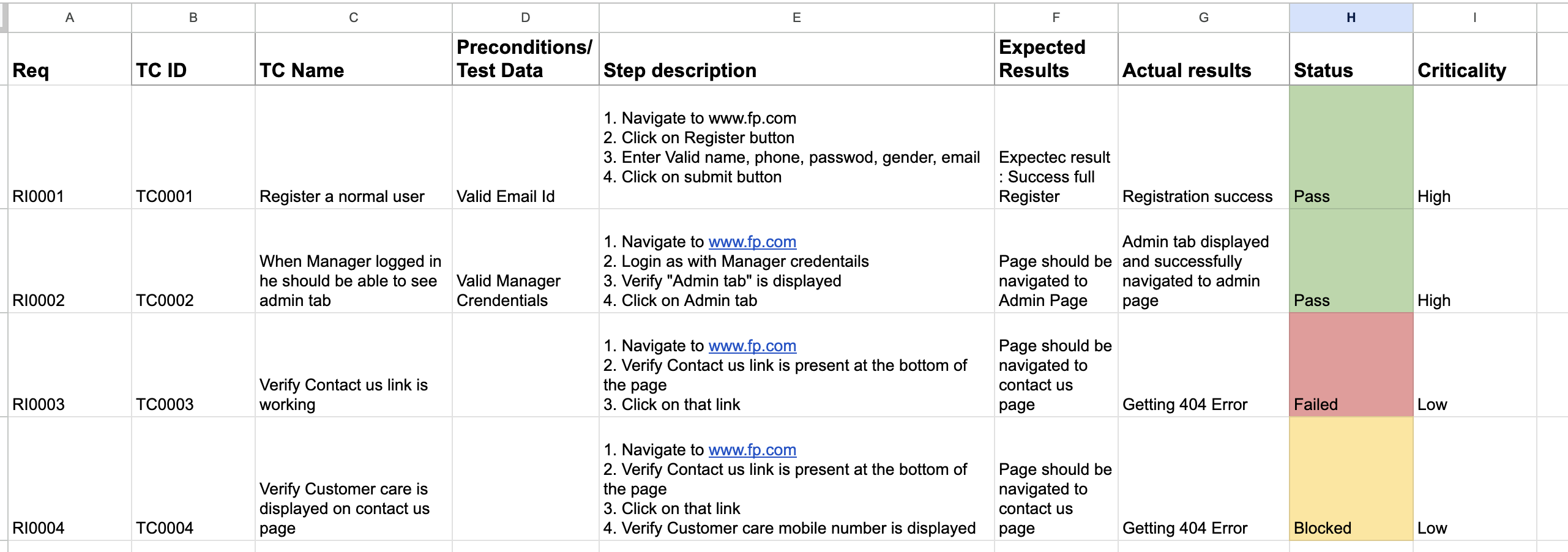
We will write testcases based on SRS document. In SRS document we will have usecases/scenarios, figma designs. Based on these this we will write testcases.
Generally Test cases will be written in Google sheet or Excel sheet.
Refer all the columns present in below sheet
In Testcase documentation we will follow
Boundary Value Analysis Technique
Equivalance Partition Technique
Environment Setup
Developers and Devops team will deploy code in target environment and they will give URL's to Testing team.
Testing will do Test data set up like creating user accounts, manager accouts, adding balances etc
Testcase Execution
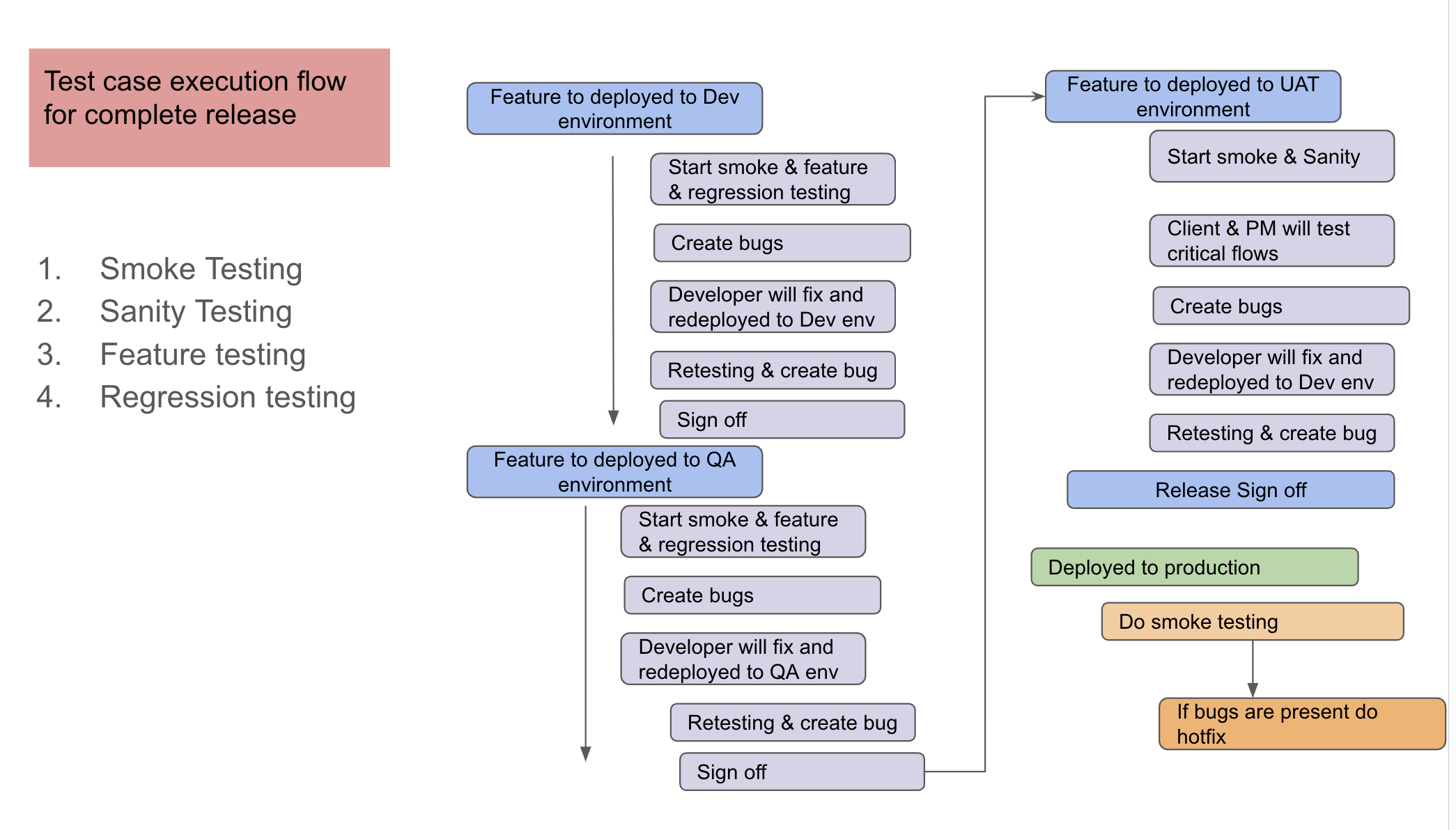
Whenever Code is deployed to environment,
First we will do smoke testing. If we found any issues, we will create high priority bugs.
Next we will do sanity testing.
Next we will do feature testing & regression testing
In this process we will create bugs
Developer will fix bugs and code will be redeployed
We will do retesting
Once everything is tested we will give sign off
Test closure activities
Preperation of release notes.
Preperation of traceability matrix.
What is Entry Criteria?
when should we start testing,
complete or partial code is developed.
test cases r written and ready
test-environment is ready
What is Exit Criteria ?
when should we stop testing,
execution of all test cases r completed
high-priority and high-seviority bugs are completed
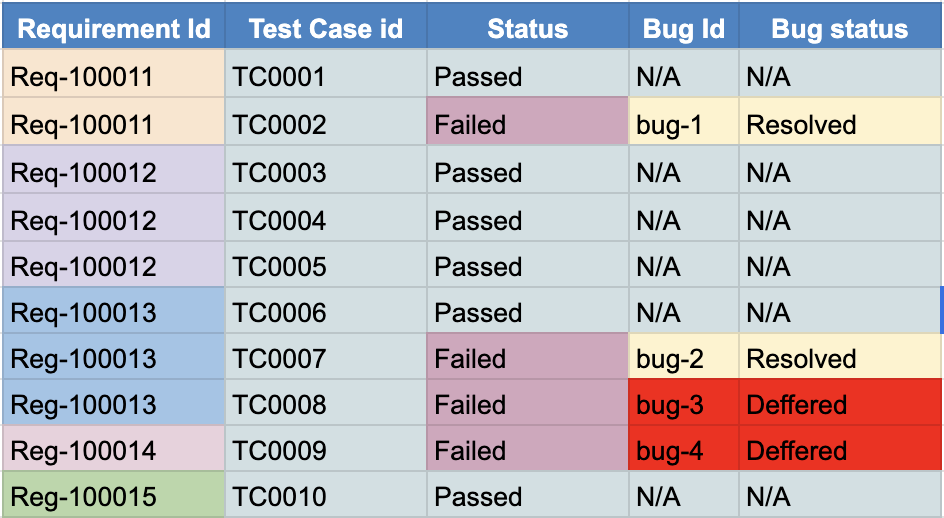
What is a traceability Matrix?
A Traceability Matrix is mapping between requirements, test cases, execution status,bugs, bug status. A traceability matrix is nothing but a document with tabular format with requirement id, Testcase id, status, bug id, bug status
What is severity ?
Severity tell the impact to the system or it will tells many user affected. Levels will be Critical, High, Medium, low. If complete system is shutdown/users are heavily impact then severity will be critical. for example:
Login is not working
Payment is failing
page not found error
What is priority?
Order in which bug is fixed. Let say we have 40 bugs, which 1st bug which need to fixed is determined by priority.
High Priority and High Severity example
Unable to login
Payment service is throwing error.
Page not found error
High Priority and Low Severity example
- Spelling mistake on logo
Low Priority and High Severity example
- Mistakes in privacy policy and disclaimers
Low Priority & Low Severity
Fonts are not as expected.
commas, full stops are missing.
What is hotfix ?
What is release notes ?
Release notes will have summary/overview about the release.
List of requirements that picked up.
List of requirements not picked up.
List of bugs that are not fixed / differed.
What is conditional sign off ?
- Some times will not time to fix bugs. In release notes we will provide all the bugs information.
Verification vs Validation
Verification is checking whether requirements, testcases and processes are correct or not. We do this using review meetings with stakeholders.
Validation is blackbox testing, whitebox testing.
What is functional testing?
Functional testing is nothing but checking requirements are satifisfied. Testing all the features of applications are working or not.
What is non functional testing ?
Non functional testing consists of Performance testing, Security testing, Cross browser functionality testing, Accessibility testing.
Performance testing : IRCTC - Tatkal booking, Amazon sale
Security testing : Facebook logins, Instagram logins
Black & White box Testing techniques
-blackbox testing is functional testing,we will not worry about internal details of the application.
-white box testing is testing internal code of the application
Best practices to follow writing testcases ?
What is beta testing?
What is project management tool ?
What is EPIC, Stories ?
What is UAT ? (Usablitiy testing)
What is adhoc testing ?
Purpose of writing testcase ?
If dev replied stating the bug we raised is Duplicate what will you do ?
What do you do to avoid duplicate bug ?
- By tags to catagorize bugs
What is prototype model
What is Test Bed
What is API Testing
What is critical bug ? Step to overcome it.
Pesticide paradox
Test harness and Test closure
Black & White box Testing techniques
-blackbox testing is functional testing,we will not worry about internal details of the application.
-white box testing is testing internal code of the application
Best practices to follow writing testcases ?
Waterfall model
In Waterfall model we have very large release for example in 6 months we have 1 release.
Agile model
In agile model we have very quick release. Here we use sprint planning, scrum, sprint retrospection to complete a release
Story Point : It tells how much time it take to complete task. In my company we add in t-shirt sizes xs,s,m,l,xl
Scrum/stand up: Daily meeting where we discuss about yesterday status, todays work
Sprint Planning, Sprint retrospection:
Sprint retrospection is discussing improvement areas, what went well , what does not went well in previous sprint.
Realtime manual questions
Here are some common real-time manual testing interview questions that focus on practical knowledge, problem-solving skills, and understanding of manual testing concepts:
1. What is the difference between verification and validation in software testing?
Explanation:
Verification: Ensures the product is being built correctly (e.g., reviewing documents, plans, code, etc.).
Validation: Ensures the correct product is being built, i.e., it meets the user’s requirements (e.g., actual testing like UAT).
2. How do you prioritize test cases in a testing project?
- Explanation: Discuss prioritization based on risk, business impact, critical functionality, and frequency of use. Mention how critical paths, core functionalities, and user-facing features usually take precedence.
3. Can you explain the different types of testing you’ve performed?
Explanation: Provide examples such as:
Smoke Testing: A basic test to check whether the build is stable.
Regression Testing: Re-testing of unchanged parts to ensure no new defects.
Functional Testing: Testing the application against the functional requirements.
Integration Testing: Testing the interfaces between components/modules.
4. What is the difference between severity and priority in defect management?
Explanation:
Severity: The impact of a defect on the system (e.g., critical, major, minor).
Priority: The urgency of fixing the defect (e.g., high, medium, low), often driven by business needs.
5. How do you ensure that all functionalities of an application are tested?
- Explanation: Discuss the use of test planning, traceability matrices (to map test cases to requirements), checklists, and comprehensive test case design. Mention reviewing requirements and working closely with stakeholders.
6. What is exploratory testing, and when would you use it?
- Explanation: Exploratory testing is an unscripted. We will just open application and test everything is working fine or not. When time is limited will do exploratory testing.
7. How do you handle a situation where you find a critical bug during the final testing phase?
Explanation:
Immediately communicate with development team and stakeholders
Analyse the impact of this bug.
Check whether we have workaround or fixes.
8. What is a test case, and what information should it include?
Explanation: A test case is a set of conditions or actions used to verify a particular functionality. It should include:
Test Case ID
Test Description
Pre-conditions
Test Steps
Expected Result
Actual Result (after execution)
Status (Pass/Fail)
Remarks
9. What are the common challenges you face in manual testing, and how do you overcome them?
Explanation:
Challenges :: Incomplete requirements, tight deadlines, Managing large test suites
How to overcome
In case of Incomplete requirements always talk with product managers and clients. Get clarified all your doubts on requirements.
Incase of tight deadlines, always complete high priority items. Inform your leads about tight deadliens.
Incase of large test suites, divde suites between your team members and maintain them.
10. How do you perform regression testing?
- Explanation: Discuss selecting test cases based on impact analysis, re-executing existing test cases after changes or fixes, and ensuring that new changes haven’t adversely affected existing functionality. Mention the importance of automation if applicable but emphasize how it’s done manually.
11. Describe a scenario where you found a difficult bug. How did you discover it and report it?
- Explanation: Provide a real-life example, explaining the steps taken to identify the bug (e.g., through exploratory testing, edge case testing), and how you documented it clearly with detailed steps, screenshots, logs, and severity/priority assessment.
12. What are some best practices you follow when writing test cases?
- Explanation: Discuss ensuring that test cases are clear, concise, and cover both positive and negative scenarios. Mention the importance of traceability, reusability, and maintaining a balance between detailed coverage and practicality.
13. How do you manage testing when requirements frequently change?
- Explanation: Talk about maintaining flexibility in your test plans, updating test cases regularly, focusing on modular test design, and maintaining close communication with the product team to ensure alignment.
14. What is defect life cycle? Can you explain the different stages?
Explanation: The defect life cycle typically includes:
New: Defect is reported.
Assigned: Defect is assigned to a developer.
Open: Developer starts working on the defect.
Fixed: Developer fixes the defect.
Test: Tester verifies the fix.
Reopen: If the issue persists.
Closed: If the defect is fixed and verified.
Deferred: If the defect is to be fixed in a later release.
Rejected: If the defect is not considered valid.
15. What is the difference between retesting and regression testing?
Explanation:
Retesting: Testing the specific scenario where the defect was found to ensure the fix works.
Regression Testing: Testing the entire application or a large portion of it to ensure that the fix hasn’t affected other functionalities.
16. How do you determine when to stop testing?
Explanation: Mention criteria like:
All critical test cases are passed.
The defect rate falls below a certain threshold.
Testing deadlines are reached with acceptable risk.
Test coverage meets the required levels.
Stakeholders sign off on the release.
17. What is boundary value analysis, and can you provide an example?
- Explanation: BVA is a testing technique. In this technique we create testcases based on boundaries of input values. For example, there is a age field. It will accept values only between 1 to 100. Here we take input as 0,1,99,100.
18. What is the role of a test plan, and what does it typically include?
- Explanation: A test plan outlines the testing strategy, objectives, resources, schedule, scope, and deliverables. It includes sections like test scope, test objectives, resource planning, test environment, risk analysis, and entry/exit criteria.
19. How do you ensure the test environment is correctly set up before testing begins?
- Explanation: Discuss steps like verifying environment configurations, ensuring the correct version of the software is deployed, checking connectivity, data setup, and ensuring all necessary tools and permissions are in place.
20. Can you explain what a traceability matrix is and its importance in testing?
- Explanation: Traceability matrix is useful in tracking test coverage. Because it contains mapping between requirements and testcases.
These questions and explanations can help you prepare for a manual testing interview, focusing on real-world scenarios and best practices.